

Professionalism Series: Briggs v. Elliott with guest speaker US District Court Judge Richard Gergel
Charleston Law will discuss Briggs v. Elliott with guest speaker US District Court Judge Richard Gergel at the Charleston Museum Auditorium.
Students can earn academic credit by participating in clinics. Students are limited to participation in two clinics for academic credit. In addition, students are prohibited from receiving academic credit for an externship and a clinic in the same semester. Please note: each clinic may not be offered every semester.
The Charleston Pro Bono Housing Clinic, the South Carolina Legal Services Domestic Violence Clinic, and the Charleston Pro Bono Family Law Clinic will involve students in the direct representation of homeless, indigent, poor, and disadvantaged persons. Students may assist in representing clients in legal matters and litigation, including landlord-tenant, eviction, housing, disability benefits, family court, criminal charges in municipal and magistrate courts, drafting wills, and the like. Students will learn firsthand what kinds of issues routinely face people at or near the poverty line or working-poor status. Students may assist professors in court or agency hearings with client representation. Students may also assist with the preparation of pleadings, motions, briefs, correspondence, and other memoranda necessary to the representation. Students may assist with client intake and other interviews necessary to prepare the clients and witnesses for various hearings.
Law Students in the Street Law Clinic will teach a weekly class at a local high school in the Lowcountry. After receiving law-related training, Law Students will develop learner-centered lessons in law to develop the critical thinking and cognitive skills of High School students. The curriculum focuses on developing an understanding of the law, the legal process, the United States system of government, and effective citizenship. Law Students and High School Students will examine the role of law, Courts, fairness, and equality in our State and in our country. Law Students will teach law courses to high school students; prepare detailed lesson plans, note-taking guides, and assessments; evaluate high school students’ work; and assign grades.
Charleston Pro Bono Legal Services provides free civil legal services to low-income residents of Charleston County. Family law issues such as divorce, custody and visitation, child support, spousal support, and birth certificate issues, including delayed or amended birth certificates and minor and adult name changes, are legal issues addressed by CPBLS attorneys. In partnership with Charleston Pro Bono Legal Services (“CPBLS”), students can take part in a Family Law Clinic to assist low-income families with their legal needs in these areas.
Students participating in the clinic will get hands-on experience in family law. The program will include participation in client intake, including eligibility determination and fact gathering; preparation of pleadings, affidavits, and other legal documents; and client follow-up to guide clients through their legal process. There will also be opportunities to observe the courtroom. As case load permits, students may have the opportunity to represent clients in Family Court under the supervision of an attorney.
Charleston Pro Bono Legal Services provides free civil legal services to low-income residents of Charleston County. Housing issues and eviction prevention are legal issues addressed by CPBLS attorneys. In partnership with Charleston Pro Bono Legal Services (“CPBLS”), students can take part in a Housing Clinic to assist low-income families with their housing-related legal needs.
Students participating in the clinic will get hands-on experience in public interest law, specifically housing law. The program will include outreach in low-income communities; client intake, including eligibility determination and fact gathering, to support our in-house and volunteer attorneys by assisting in the preparation of pleadings, affidavits, and other legal documents. There will also be opportunities to observe the courtroom, along with in-house sessions led by Charleston attorneys. Students will have the opportunity to represent clients in Housing Court under the supervision of an attorney.
South Carolina Legal Services (SCLS) is a statewide non-profit law firm that provides free legal services to residents and families in South Carolina who are at or below 200% of the Federal Poverty Guidelines. The SCLS Domestic Violence Clinic focuses on the skills necessary for client representation, the ethical issues that arise in domestic violence cases, and the roles of the attorney and counselor. Students participating in this clinic will represent victims of domestic violence in Order of Protection (OOP) hearings under the supervision of clinical professors who are licensed to practice law in South Carolina.
Students undertake all steps necessary to prepare for court hearings. Students interview clients, review court documents from related cases or prior proceedings, prepare direct and cross-examination, make strategic decisions, and draft documents. OOPs available to clients include a broad spectrum of relief designed to effectively end abuse in an intimate relationship. An OOP may order the respondent to stop assaulting and threatening the client, to stay away from the client, the client’s home, and the client’s workplace, vacate the shared residence, and issue a no-contact order. The order may also resolve family law issues, including an award of temporary custody of the parties’ children, visitation rights for the non-custodial parent, and child support awards.
The Criminal Prosecution Clinic is designed to provide students with a practical, real-world experience in the challenging and rewarding field of criminal prosecution. This clinic serves as a bridge between classroom learning and the demanding reality of the courtroom. Under the close supervision of an experienced attorney, students will be actively involved at every stage of the prosecution process, including interviewing witnesses, presenting plea agreements, identifying issues in cases, conducting research, preparing legal memoranda, and presenting witnesses at hearings and trials.
Students will receive guidance and constructive feedback to further develop their courtroom confidence. Students will gain a deeper understanding of the ethical responsibilities and unique challenges faced by a criminal prosecutor— not simply as an advocate, but as a minister of justice. Students will refine their ability to demonstrate professionalism and civility in an inherently adversarial environment, pursuing justice with integrity.
The Mediation Clinic focuses on acquiring skills and engaging in experiential learning necessary for conducting effective mediation within and outside the legal system. The clinic introduces mediation as a powerful alternative to litigation, including foundational principles of confidentiality, neutrality, voluntary engagement, self-empowerment, and informed consent, while clarifying and emphasizing the roles of attorney, advocate, and counselor during the process. Students participating in the clinic will serve as mediators in civil and community cases under the supervision of clinical professors who are attorneys licensed to practice law in South Carolina.
Designated Experiential Learning Course (Formerly Skills)
As part of the experiential learning process, students will undertake all steps necessary to prepare, conduct and conclude the mediation session(s), including review of associated court or case documents, preparation and information gathering with and from parties, conducting introductory, exploration, bargaining, options evaluation, agreement writing and final reporting phases of the mediation session(s), and identifying next steps. Students engage directly with parties and counsel, directing the mediation process to ensure a sustainable outcome. Students help parties reach mutual agreement, all the while demonstrating empathy, emotional skills, and ability to effectively distill and deal with issues in a manner that helps lead parties to agreement, while avoiding the further uncertainty and costs of litigation or preempting litigation altogether.
The weekly seminar will cover mediation in civil and community cases, including family, magistrate, court of common pleas, probate, US district, and heirs’ property. Lectures will cover basic elements of an introductory mediation course, including in-depth role-plays and a review of South Carolina’s mediation rules.
Students are required to attend a weekly seminar and to complete 150 hours of clinical work (approximately 11 hours/week during the semester).
Additional information about the Mediation Clinic:
Students interested in earning academic credit in a clinic must apply through CORE by the specific deadline for a particular semester. The clinic will then review applications and decide to which students an offer will be extended. All offers will be extended on the same day and students will have a specific deadline by which they must accept an offer.
The following clinics are currently on hiatus:
Charleston Law will discuss Briggs v. Elliott with guest speaker US District Court Judge Richard Gergel at the Charleston Museum Auditorium.
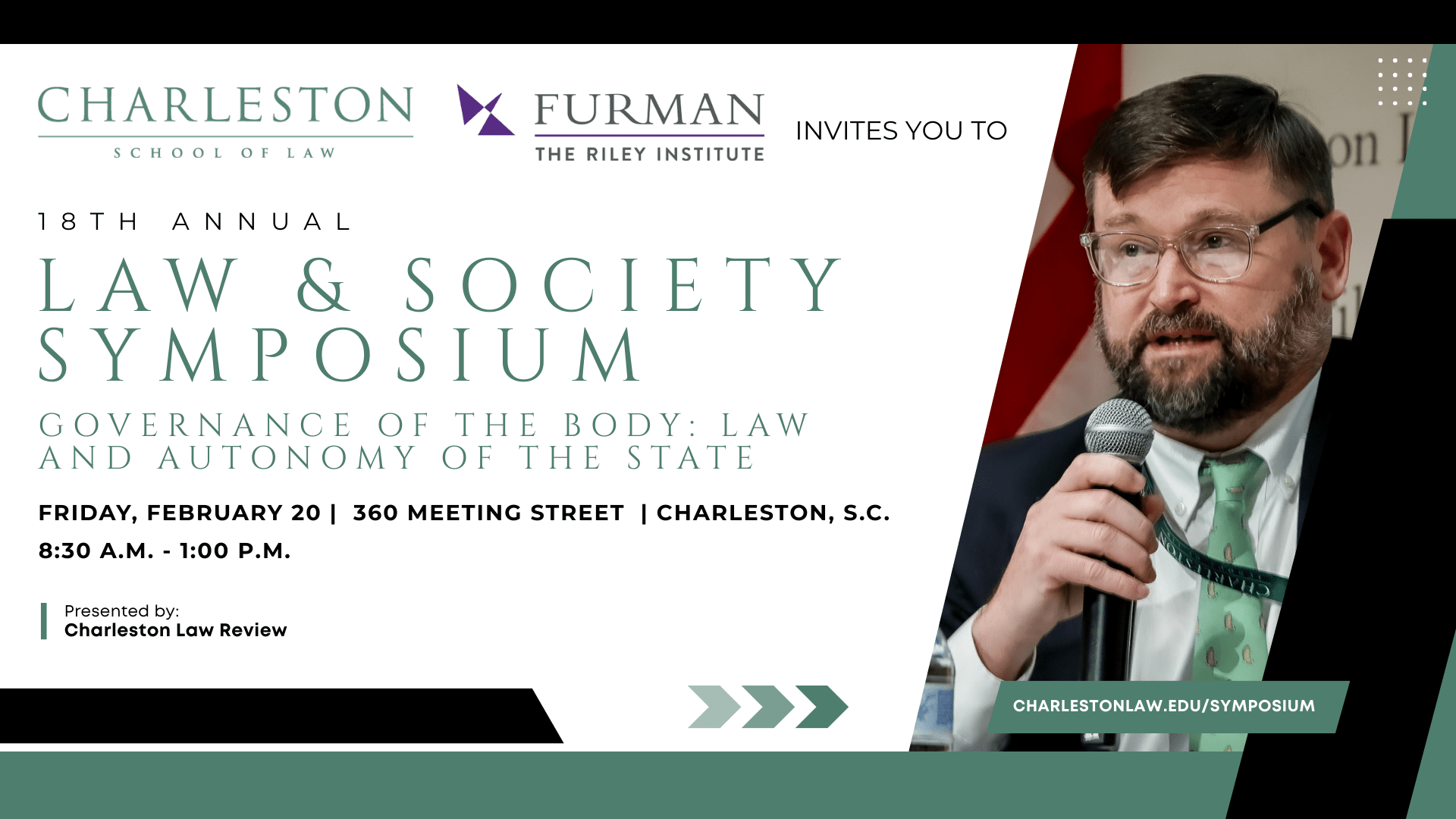
Charleston Law Review and the Riley Institute at Furman University will host the 18th annual Law & Society Symposium at the Charleston Museum Auditorium on Friday, February 20.